
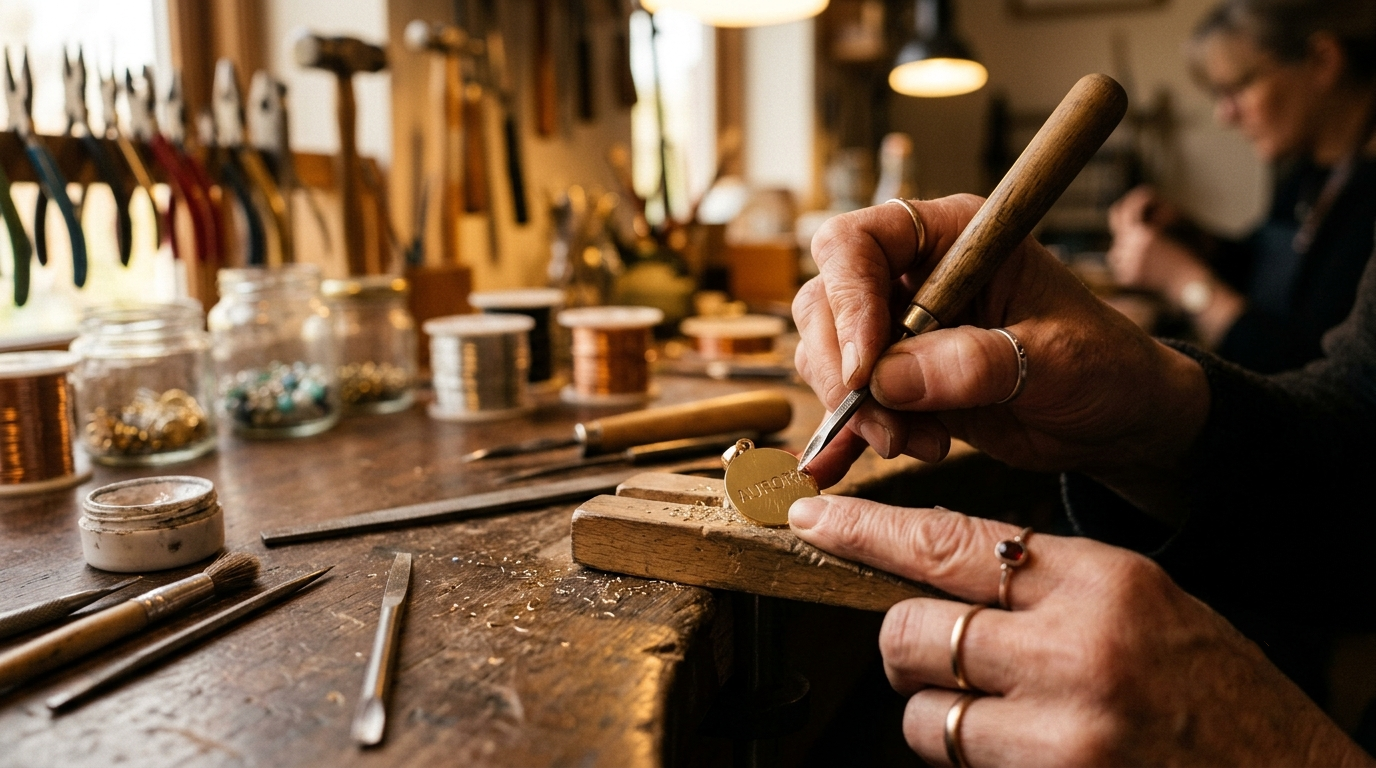
Every personalised piece starts the same way: a blank surface, and a decision about what deserves to live on it forever. The rest — the metal, the font, the placement — is simply the craft of getting that decision right.
Start with the Piece, Not the Design
Before you think about names or dates, decide where the personalisation will actually live. Each piece carries a different kind of intimacy, and that changes what you should put on it.
- Necklaces sit closest to the heart and have the most surface area — ideal for names, short phrases, or a small photo pendant. Browse the necklace collection.
- Bracelets are seen constantly throughout the day, which makes them perfect for shared symbols — coordinates, matching initials, or a projection photo two people can both wear. See the bracelet collection.
- Rings have the smallest engraving canvas, so they reward brevity — a date, a single word, or a split phrase across two bands. Explore the ring collection.
- Earrings are worn in pairs, which opens the door to two-part personalisation — one initial per ear, or a matching birthstone set. View the earring collection.
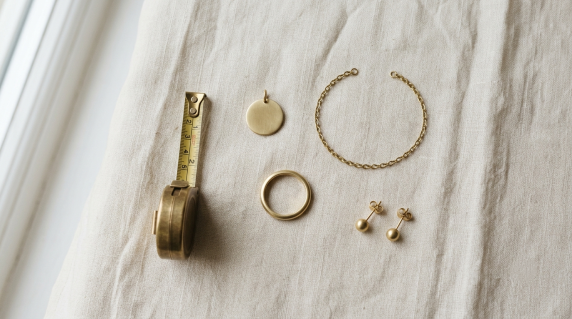
The four most common starting points: pendant, bracelet, band, and stud.
Decide What You're Actually Saying
This is the step people rush, and it's the one that matters most. The engraving is permanent, so it's worth spending five real minutes deciding what belongs on the metal.
- A name or nickname — the most direct option. Works beautifully on necklaces and bracelets, and reads as confident rather than sentimental.
- A date — a wedding day, a first meeting, a birth. Dates are quiet by nature; only the wearer knows what they mean, which is part of the appeal.
- Coordinates — the latitude and longitude of a meaningful place. Slightly more unusual, and a favourite for anniversary rings and bracelets.
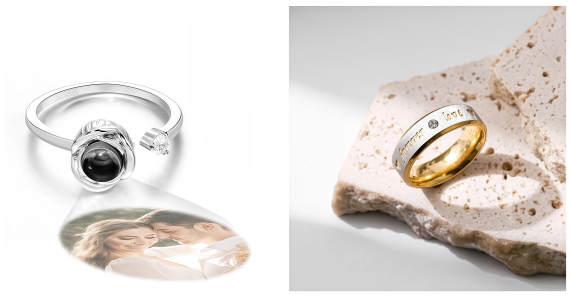
- A photo — either laser-engraved as a fine-line portrait, or hidden inside a projection pendant that reveals the image only when held to light.
- A birthstone — not an engraving at all, but a colour-based way to personalise. Often combined with a name, as in a birthstone necklace.
"The shorter the engraving, the longer it stays meaningful." Long phrases can feel dated after a few years; a name, a date, or a single word tends to age much better.
Choose Your Personalisation Technique
Once you know what you want to say, the next question is how it should be made visible — and this is where a lot of buyers don't realise they have options beyond simple engraving.
Laser engraving in progress — one of several ways a message can live on metal.
| Technique | Best For | Visibility | Character Limit |
|---|---|---|---|
| Laser Engraving | Names, dates, short phrases | Always visible | Usually 20–30 characters |
| Photo Projection | A specific photo or memory | Only visible when held to light | Not text-based |
| Fine-Line Portrait Engraving | Faces, pets, landscapes | Always visible | Single image |
| Birthstone Setting | Colour-based personalisation | Always visible | Combined with 1 name typically |
If you can't decide, this is a useful shortcut: engraving suits people who want their message seen; projection suits people who want it kept private, almost like an inside joke only the wearer knows about.
Pick a Metal That Matches How It Will Be Worn
The metal isn't just a finish — it decides how well your engraving survives daily wear, showering, and years of small bumps.
| Metal | Durability | Best For | Care Note |
|---|---|---|---|
| Stainless Steel | Very high, scratch- and tarnish-resistant | Daily wear, active lifestyles | Wipe with a soft cloth |
| S925 Sterling Silver | Moderate, may tarnish over time | Elegant, special-occasion pieces | Store in an anti-tarnish pouch |
| Gold-Plated / Rose-Gold | Moderate, plating wears with friction | Warm-toned, dressier looks | Avoid perfume and lotion contact |
| Copper (Plated) | Good, may oxidise if plating wears | Vintage-style projection pieces | Keep dry, wipe after wear |
A simple way to decide: if the piece will be worn every single day — a bracelet, everyday earrings — lean toward stainless steel. If it's reserved for special occasions, S925 silver or gold-plated finishes will do more visual work.
Get the Wording and Font Right
Most personalisation mistakes happen here — not in the idea, but in the execution. A few practical rules make a real difference:
- Keep it under 20 characters where possible. Small pendants and ring bands physically can't hold long phrases without losing legibility.
- Script fonts feel romantic and work well on necklaces and rings; block fonts feel confident and read clearly at a glance on bracelets.
- Avoid special characters your engraving machine may not support cleanly — accented letters and emoji are best confirmed with the seller first.
- Write dates the way you'll want to remember them — "06.18.2019" reads differently than "June 18th, 2019," and both are valid, so pick the one that feels most like you.
- Double-check spelling before submitting. Engraving is usually final, and rush corrections are rarely free.
Same name, three fonts — small choices that change the entire feel of the piece.
Get the Sizing Right the First Time
Personalised pieces are harder to resize than plain ones, since resizing can affect the engraving. A little measuring upfront saves a lot of disappointment later.
If you're buying as a surprise and can't measure directly, an adjustable design removes the guesswork entirely — a good middle ground when precision isn't possible.
Think About Where the Personalisation Sits
The same message can feel completely different depending on where it's placed:
- Front and visible — a name across the front of a pendant, or along the outside of a ring band. This is a statement piece, meant to be noticed.
- Inside the band — the classic choice for rings, keeping the message private between the wearer and whoever gave it. Only visible on close inspection.
- Concealed in a projection setting — an image is etched at a microscopic scale and only becomes visible when the pendant is held to a light source. This is the most private option of all.
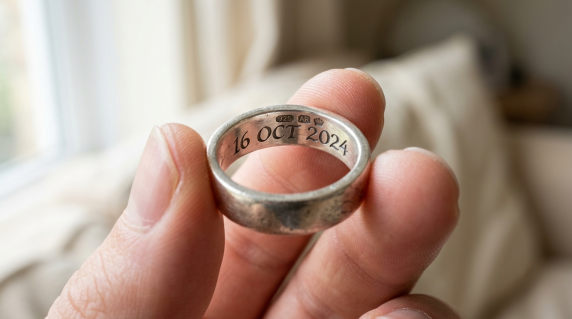
Inside-the-band engraving — visible only when the wearer chooses to look.
"I asked for the coordinates to go inside the band instead of outside. Nobody else notices it, but I know it's there — and honestly, that's exactly why I love it."
How the Ordering Process Actually Works
Once you've made your decisions, the process itself is simple. Here's what to expect from most personalised jewellery orders, including ours:
- Select your piece and options — metal, chain length, or ring size, directly on the product page.
- Enter your text or upload your photo in the personalisation box at checkout. For projection pieces, a clear, well-lit photo produces the sharpest result.
- Review your order confirmation carefully — this is your last chance to catch a typo before production begins.
- Production takes a few extra days compared to non-personalised items, since each piece is made to order rather than pulled from stock.
- Your piece ships with care instructions and, for projection jewellery, a small note on how to view the image properly.
Caring for a Personalised Piece
Personalised jewellery gets worn more often than "special occasion only" pieces, simply because people want to keep it close. A few habits keep the engraving sharp for years:
- Remove jewellery before swimming, showering, or exercising — moisture and friction wear down fine engraving fastest.
- Store pieces separately, ideally in a soft pouch, so engraved surfaces don't scratch against other metal.
- Wipe with a soft, dry cloth after each wear to remove oils and residue before they build up in the engraved lines.
- For deeper cleaning, use a mild soap solution and a soft brush, then dry thoroughly before storing.
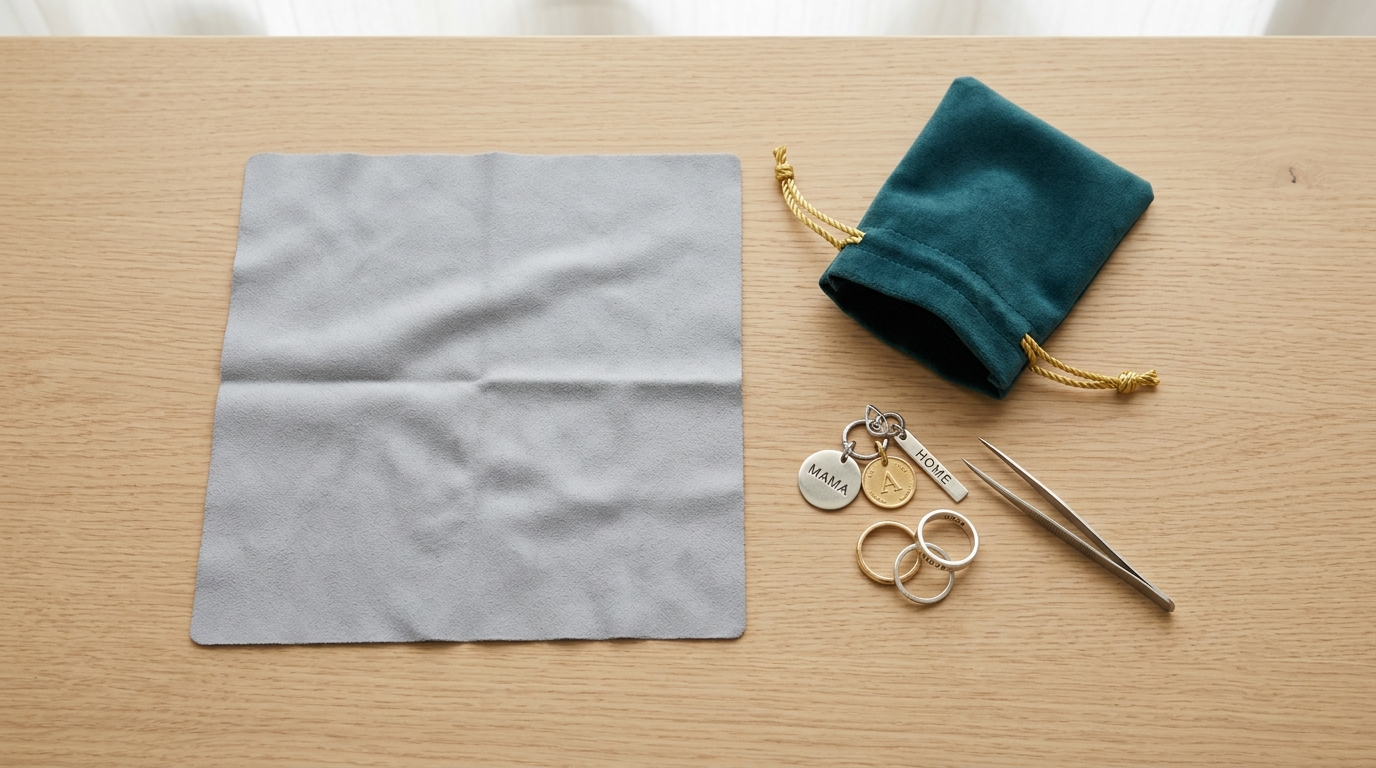
A soft cloth and a proper pouch — the two habits that make engraving last.
Frequently Asked Questions
How many characters can I usually engrave?
It depends on the piece and technique, but most necklace pendants and bracelets allow 20–30 characters, while ring bands are more limited — often 15–20 characters, since the inner curve is a smaller canvas.
Can I personalise a piece with more than one name or date?
Yes, many designs support combined personalisation — for example, two names split across a set of matching rings, or a name paired with a birthstone on one necklace. Just check the specific product's customisation options before ordering.
What happens if I misspell something in my order?
Because personalised pieces are made to order, corrections after production has started usually aren't possible without a remake fee. Always double-check your text in the order confirmation before submitting.
Is photo projection jewellery hard to see?
Not once you know how it works — hold the pendant a few centimetres from a phone flashlight or any bright light source, angled so the light passes through, and the image projects clearly onto a nearby surface.
Which metal should I choose if I have sensitive skin?
Stainless steel and S925 sterling silver are the safest starting points for sensitive skin, since both are widely considered hypoallergenic. Gold-plated and copper pieces can still be a good choice, just with slightly more care around moisture and friction.