
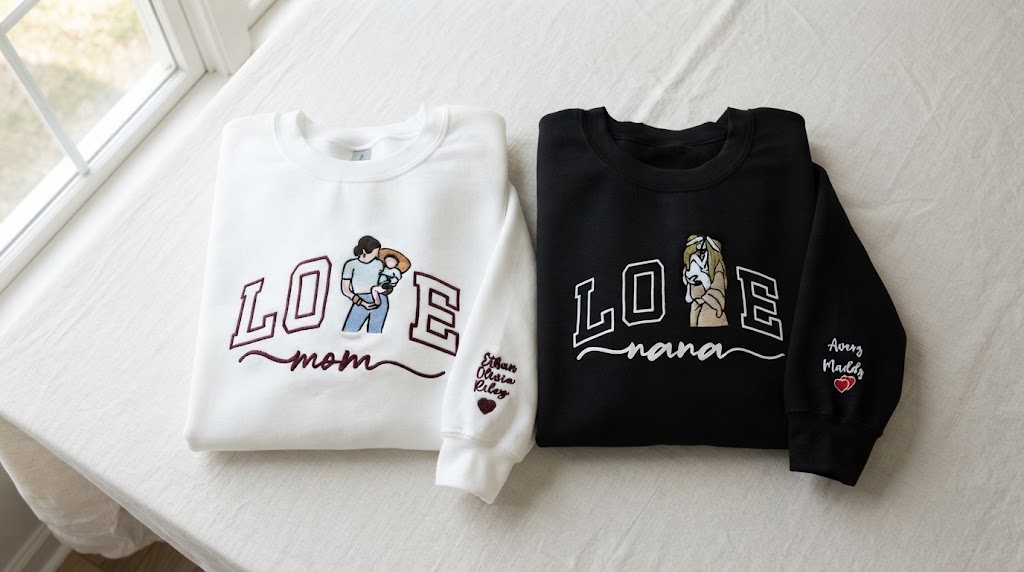
The question isn't which finish is better in general — it's which one fits the specific design going on the sweatshirt. An embroidered name and a printed company logo solve different problems, and picking the wrong one is the most common regret in a personalized sweatshirt order.
Here's the decision broken down by what's actually going on the garment, using two real examples: an embroidered photo design, and a printed logo.
Embroidered Example
Photo, Name, and Date
The Mom & Kids Photo Sweatshirt combines an embroidered design with a name and date, built around a real photo.
See the Mom & Kids SweatshirtWhat Each Finish Actually Does
Embroidery stitches a design directly into the fabric using thread, producing a raised, textured result that holds up to repeated washing without fading or cracking. Printing applies ink or a transfer — often DTF (direct-to-film) printing — to the surface of the fabric, producing a flatter finish that reproduces fine detail, gradients, and full color more accurately than thread can.
The practical difference shows up mostly in two places: how the design feels under a hand run across it, and how it looks after a year of regular washing. Embroidery has a slight physical texture from day one and keeps that texture more or less indefinitely, since the thread is worked into the weave rather than sitting on top of it. A printed design starts out perfectly flat and smooth, and depending on the ink or transfer method used, can soften or very slightly dull in vibrancy over many wash cycles — which is rarely noticeable, but is part of why embroidery is often recommended for pieces meant to be worn for years rather than one season.
Embroidery vs. printing
| Design element | Embroidery | Printing |
|---|---|---|
| Name or initials | Best fit | Works, less textured |
| Full-color photo | Limited detail | Best fit |
| Company or brand logo | Works for simple marks | Best fit, especially front & back |
| Long-term, frequent washing | Best fit | Holds up, but flatter over time |
| Turnaround | Standard | Often faster |
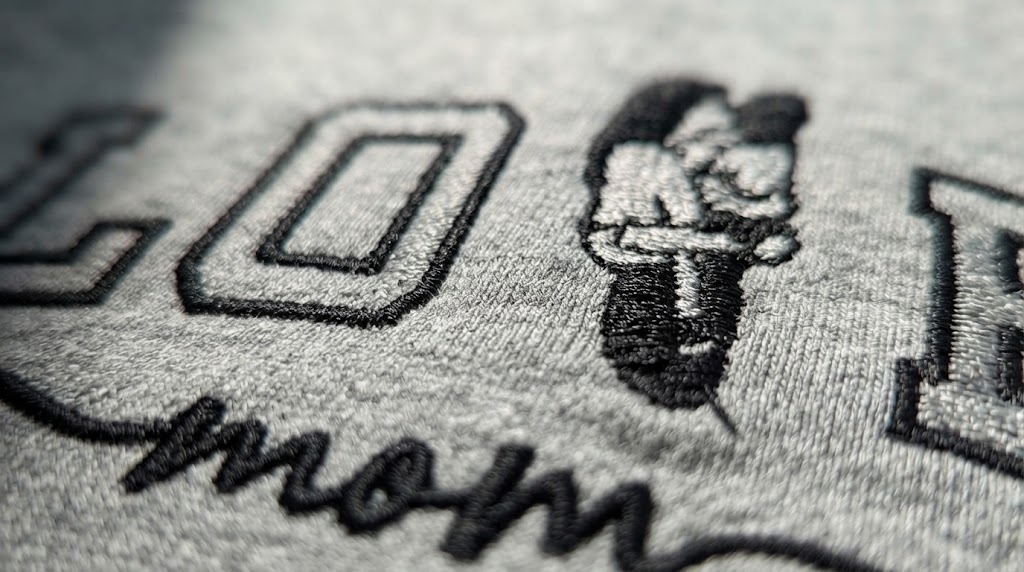
Embroidery's raised thread texture holds up well to repeated washing, which matters for names and dates meant to last.
The right finish isn't the one that sounds fancier. It's the one that matches what's actually going on the sweatshirt.
Case Study: A Printed Logo, Front and Back
The Custom Business & Brand Logo Sweatshirt is a good example of where printing is simply the better tool: it uses DTF printing to put a logo on both the front and back of the hoodie, something that would be slower and more expensive to embroider at that scale, especially across a bulk team order.
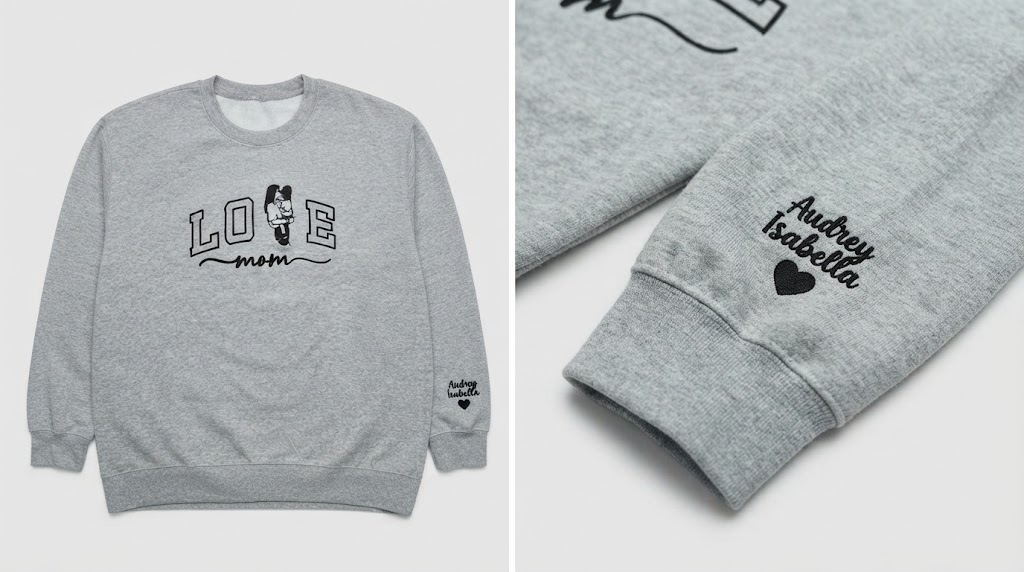 Front: "LOVE MOM" embroidered across the chest. Sleeve: each child's name stitched in, one by one.
A Note on Cost and Turnaround
Neither finish is reliably cheaper across the board — pricing depends more on the complexity of the specific design and the individual product than on embroidery versus printing as a category. Where the two do tend to differ is speed and setup: a simple printed design, especially on a single placement, is often quicker to produce than an equivalently detailed embroidery, since stitching takes physical time proportional to the design's complexity in a way that printing generally doesn't. For a rush order or a large bulk run, that difference in production time can matter more than the finish itself.
Quick Verdict
- Name, initials, or a date — go embroidered
- A full-color photo — go printed
- A company or brand logo, especially front and back — go printed
- A simple line-art design — either works; embroidered for texture, printed for exact color
- Not sure — embroidered is the safer default for anything meant to be worn for years

A combined design — embroidered text with a photo element — covers both a keepsake feel and a specific memory.
Choosing Yours
- Identify the core design element — text, a photo, or a logo.
- Match the finish to that element using the table above.
- Consider how often it'll be worn and washed — embroidery holds up longer under frequent laundering.
- Check if the design needs multiple placements, like front and back — printing usually scales better for that.
Frequently Asked Questions
Is embroidery more expensive than printing?
Pricing depends on the specific product and design complexity rather than the finish alone — check the individual product page for exact pricing.
Can a sweatshirt combine both embroidery and printing?
Some designs, like an embroidered name paired with a photo element, do combine both — check the specific product's personalization options to confirm what's available.
Why do team and company hoodies usually use printing instead of embroidery?
Printing, especially DTF printing, handles larger designs and front-and-back placement more efficiently than embroidery, particularly across bulk orders.
Does embroidery fade faster or slower than printing?
Embroidery generally holds up well over repeated washing since the thread is worked into the fabric rather than sitting on its surface.
Which finish is better for a sweatshirt meant to be worn for years?
Embroidery tends to be the more durable choice for long-term, frequent wear, particularly for text-based designs like names or dates.
Printed Example
Logo, Front and Back
DTF-printed business or brand logo sweatshirts for teams and company gifts.
See the Custom Logo SweatshirtNeither finish is universally better. The design decides — match it, and the rest of the order is easy.